Messy History
Seminar, Design history and theory
B.A. and M.A.
Seminar description/ Seminarbeschreibung:
EN
In the seminar Messy History, we look at dominant narratives of canonical design historiography from an intersectional-feminist and decolonial perspective and discover, among other things, that "history is not the past".
We thus approach highly topical issues such as neo-colonialism, gender difference, sustainability and cultural appropriation and show their connection to the design practice.
Instead of linear narratives, dates and name-dropping, this course focuses on the approach and tools for working with design history. Together we will read, discuss, research, practice factual and logical argumentation and, ideally, overturn many of our preconceptions about design.
DE
Im Kurs Messy History betrachten wir dominante Narrative der kanonischen Designgeschichtsschreibung aus intersektional-feministischer und dekolonialer Perspektive und stellen u.a. fest: „Geschichte ist nicht Vergangenheit“.
Wir nähern uns damit hochaktuellen Themen wie bspw. Neokolonialismus, Geschlechterdifferenz, Nachhaltigkeit und kultureller Aneignung und zeigen deren Verbindung zur Designpraxis auf.
Anstelle linearer Erzählstränge, Jahreszahlen und Namedropping, liegt in diesem Kurs der Fokus auf der Herangehensweise und den Werkzeugen zum Umgang mit Designgeschichte. Gemeinsam werden wir lesen, diskutieren, recherchieren, sachliches und logisches Argumentieren üben und im besten Falle viele Vorannahmen über Design über den Haufen werfen.
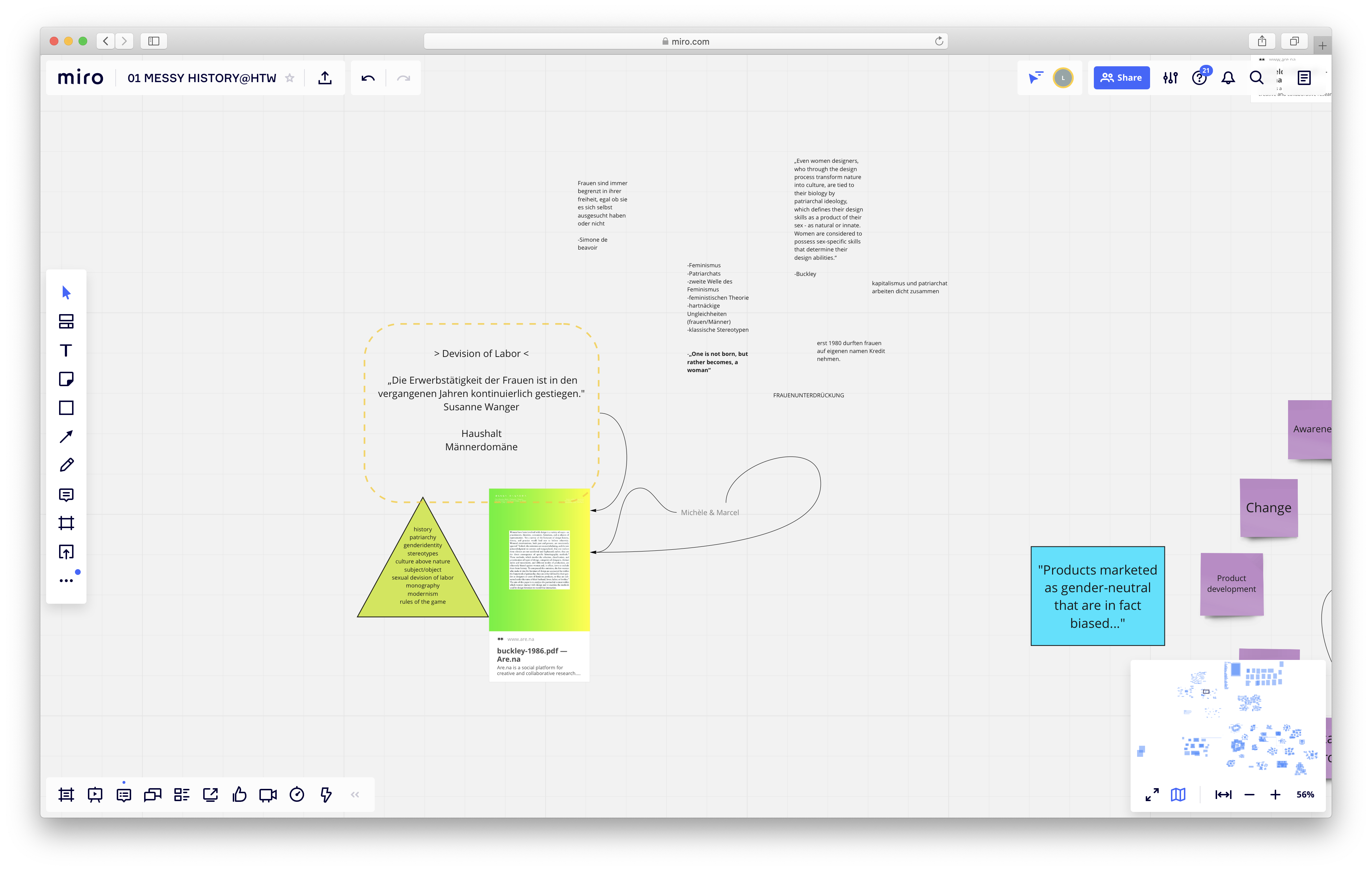

Snapshots of the seminar’s Miro
Taught at University of Arts Berlin, University of Applied Sciences Berlin (HTW Berlin) and at University of Arts Bremen.
Selected Literature:
![]()
Martha Scotford: Is There a Canon of Graphic Design History? AIGA Journal, vol.9 (2), 1991. Re-published in: Marie Finamore, Steven Heller (Eds.): Design Culture: An Anthology of Writing from the AIGA Journal of Graphic Design. New York: Allworth Press, 1997.
Aggie Toppins: Can We Teach Graphic Design History Without the Cult of Hero Worship?. Aiga Eye on Design Magazine, 2020. https://eyeondesign.aiga.org/can-we-teach-graphic-design-history-without-the-cult-of-hero-worship/
Cheryl Buckley: Made in Patriarchy — Toward a Feminist Analysis of Women and Design. In: Design Issues Vol. 3, No. 2, Fall, 1986.
Rosa Menkman: Behind the White Shadows of Image Processing, 2018.https://beyondresolution.info/Behind-White-Shadows
Paul B. Preciado: Trashgender – Urinate/Defecate, Masculine/Feminine. In: The Funambulist (13): Queers, Feminists & Interiors, 2017.
Sasha Costanza-Chock: Design Justice: towards an intersectional feminist framework for design theory and practice. June 3, 2018. Proceedings of the Design Research Society, 2018.
Cynthia Enloe: „The Globetrotting Sneaker.“ In: The Curious Feminist. Berkeley: University of California Press, 2004, p. 43–56.
Anoushka Khandwala: “What does it mean to decolonize design?“ In: AIGA Eye on Design Magazine, 2019. https://eyeondesign.aiga.org/what-does-it-mean-to-decolonize-design
Sojin and Somi Kim: “Type Cast: meaning, culture, and identity in the alphabet omelet published”. In: Earthquakes & Aftershocks, les affiches du California Institute of the Arts, 1986–2004 / Posters from the CalArts Graphic Design Program 1986–2004. Rennes: Presse universitaire de Rennes. 2005, p. 113 – 128. Originally published in: Lift and Separate: Graphic Design and the Vernacular. New York: The Herb Lubalin Study Center of Design and Typography, 1993.
Selected Literature:

Martha Scotford: Is There a Canon of Graphic Design History? AIGA Journal, vol.9 (2), 1991. Re-published in: Marie Finamore, Steven Heller (Eds.): Design Culture: An Anthology of Writing from the AIGA Journal of Graphic Design. New York: Allworth Press, 1997.
Aggie Toppins: Can We Teach Graphic Design History Without the Cult of Hero Worship?. Aiga Eye on Design Magazine, 2020. https://eyeondesign.aiga.org/can-we-teach-graphic-design-history-without-the-cult-of-hero-worship/
Cheryl Buckley: Made in Patriarchy — Toward a Feminist Analysis of Women and Design. In: Design Issues Vol. 3, No. 2, Fall, 1986.
Rosa Menkman: Behind the White Shadows of Image Processing, 2018.https://beyondresolution.info/Behind-White-Shadows
Paul B. Preciado: Trashgender – Urinate/Defecate, Masculine/Feminine. In: The Funambulist (13): Queers, Feminists & Interiors, 2017.
Sasha Costanza-Chock: Design Justice: towards an intersectional feminist framework for design theory and practice. June 3, 2018. Proceedings of the Design Research Society, 2018.
Cynthia Enloe: „The Globetrotting Sneaker.“ In: The Curious Feminist. Berkeley: University of California Press, 2004, p. 43–56.
Anoushka Khandwala: “What does it mean to decolonize design?“ In: AIGA Eye on Design Magazine, 2019. https://eyeondesign.aiga.org/what-does-it-mean-to-decolonize-design
Sojin and Somi Kim: “Type Cast: meaning, culture, and identity in the alphabet omelet published”. In: Earthquakes & Aftershocks, les affiches du California Institute of the Arts, 1986–2004 / Posters from the CalArts Graphic Design Program 1986–2004. Rennes: Presse universitaire de Rennes. 2005, p. 113 – 128. Originally published in: Lift and Separate: Graphic Design and the Vernacular. New York: The Herb Lubalin Study Center of Design and Typography, 1993.